Anyone who has automated a real process, not a demo, knows the exact moment it breaks. It is not the typical case. It is the exception: the document that arrives with a field that does not match the system, the request that talks about two things at once.
The flow stops there, because there is a decision to make: let it through, hold it, or hand it to someone. And today a person makes that decision.
To avoid it we have two tools. The rule: if the amount matches and the vendor matches, approve. Fast and auditable, but it only covers what someone anticipated when writing it. And the language model, which decides well in cases no rule foresaw.
We have taken both into production inside real processes at mid-size and large companies, and that is where we learned where they perform and where they do not.
Where they do not perform is the small, repetitive decision that has to be made thousands of times a day. A conversational model takes seconds where the flow needs milliseconds, charges for every word it generates, and answers with text that has to be interpreted again.
Above all, it does not say how confident it is. A person can tell "this is clearly right" from "this makes me doubt". Our systems did not have that distinction.
What JEV is and why it matters
On September 15, TypeSafe AI introduced JEV, the first model in a category they call System One. Behind it is Diogo Almeida, one of the researchers behind the human feedback training that made chat with AI possible.
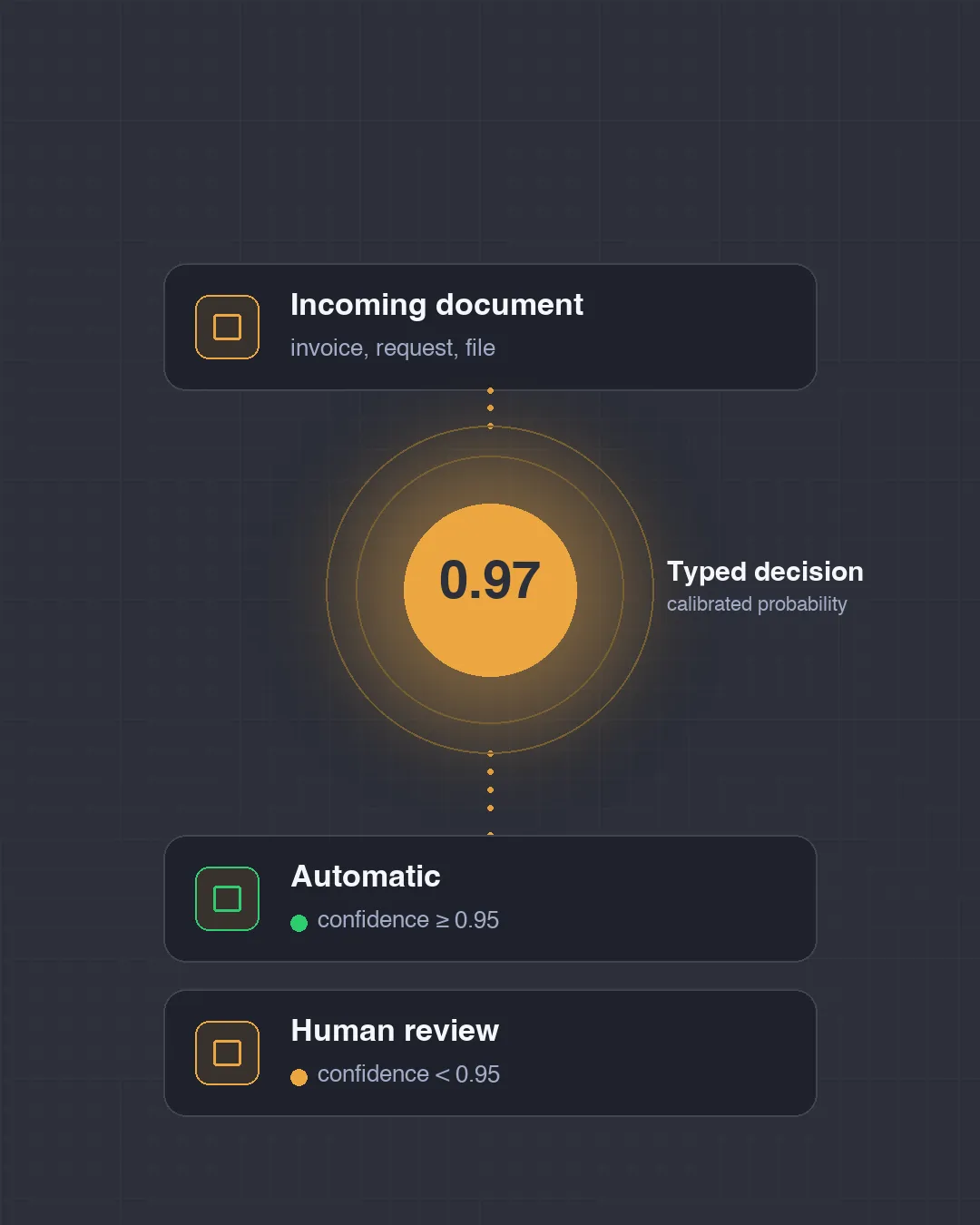
It is a model that does not generate text. It takes the context, structured or not, and returns a typed decision: an option from a closed list, a score, a true or false. And with every decision, a calibrated probability: when it says 90 percent, it is right nine times out of ten.
It answers in tens of milliseconds, costs a fraction of a conversational model because there is no output text to bill, and cannot return anything outside the type it was asked for.
It does not replace language models. It complements them where they are overkill: the language model understands and writes; the decision model chooses and says how confident it is. There will be several like it, from several providers, within months. What matters is what they enable in the design of a process.
The threshold becomes a business policy
When every decision comes with an honest probability, the question changes. It is no longer "do we automate this step or not?", but "from what confidence do we let it through on its own?".
Above the threshold, the flow continues automatically. Below it, the decision goes to a person, with the context organized and a recommendation.
And the process owner sets that threshold according to the cost of being wrong: a payment can demand 98 percent; classifying a request is fine at 80.
It is the concrete form of something we have defended for a long time: in every process that moves money or talks to customers, the person stays in the loop. Not as a bottleneck that reviews everything, but as the one who resolves what the machine admits it does not know.
Where it lands tomorrow
In customer and vendor onboarding, where every file brings documents someone verifies. One decision per document lets the clear files through and focuses the team on the ones with something odd.
In shared inboxes, where emails and forms are distributed by hand. Area, urgency and type of request in a single call.
And at the output of a conversational assistant. Before answering a customer, a quick decision on whether the answer complies with policy or needs a human.
What has to be solved first
Where the data lives. Today JEV runs in the United States and its provider publishes no region or retention commitments. For a regulated company that means working with pseudonymized data or waiting until it reaches its cloud.
Traceability. Every automatic decision is recorded with its input, output, confidence and what happened next. It is the only way to adjust the threshold with evidence.
Provider independence. The flow should not know which model serves it, so you can start today with the one available and swap it without touching the process.
The advantage is not the model
Everyone will have the model, at the same price, on the same day. The advantage lies in having processes clearly described, data in order, and a decision layer where the new thing plugs in without rebuilding anything.
It is the same pattern we saw with the cloud and with language models: whoever has the house in order adopts in weeks; whoever does not spends months cleaning up before being able to try.